
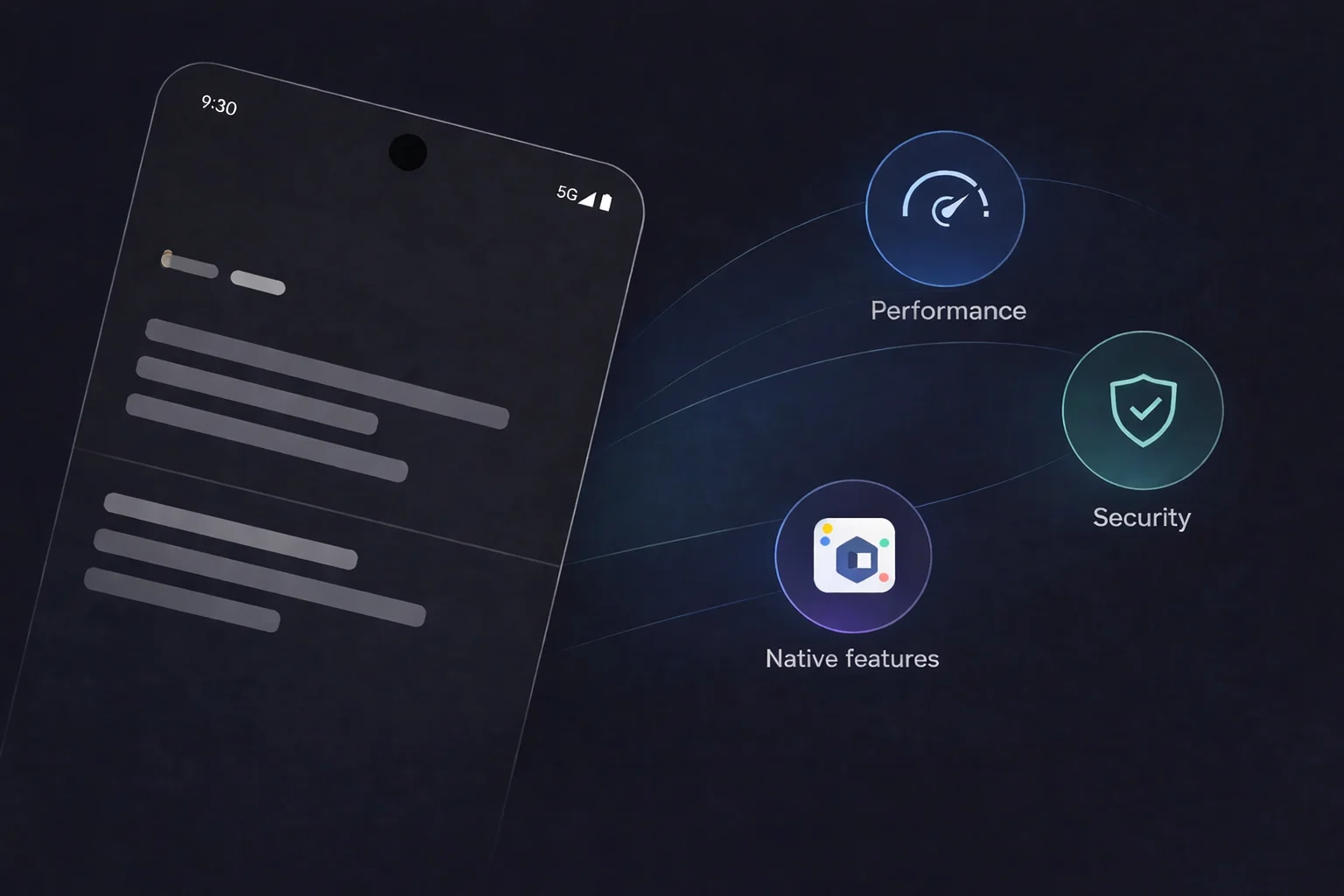
Building a mobile application has become one of the most powerful ways for businesses to create direct communication channels with users, increase customer engagement, strengthen brand awareness, and offer accessible, convenient experiences. In many cases, organizations choose native app development because of its ability to deliver exceptional performance, higher security, faster execution, and refined user experiences. When done well, a native app can elevate the way customers perceive a brand.
Cross-platform app development frameworks such as Flutter and React Native offer alternative approaches by enabling developers to build a single codebase for multiple operating systems. These alternatives have become increasingly popular among businesses that want to cut development costs and reduce delivery time. However, many organizations still favor native development when performance, scalability, and platform-specific features are of high importance.
Although the entire journey can be complex, a clear understanding of each stage can dramatically increase the likelihood of creating a successful native application. This comprehensive guide is designed to help you navigate each of these stages and build a high-performing native mobile app that supports your business goals.
What Does Native Mean?
A native application is a software program built specifically for a particular operating system. If a business chooses to build an application for iOS, for example, the development process must follow Apple’s recommended programming languages, design philosophies, and system requirements.
In practical terms, this means using Swift or Objective-C and writing code that interacts seamlessly with Apple’s native tools, frameworks, and APIs. The same applies to Android. When developers build an Android application, they use languages such as Java or Kotlin inside Android Studio, Google’s official development environment. The resulting applications behave optimally on the devices for which they were built, because they have been designed in alignment with the platform’s technical standards and capabilities.
Building an application specifically for one operating system means developers can take full advantage of all hardware and software features available on that platform. Native applications integrate more deeply with system-level functions, which makes them faster, smoother, and generally more responsive than apps built using cross-platform or hybrid technologies. This deeper integration also allows native applications to deliver experiences that feel intuitive and consistent to users, because the apps follow familiar interface patterns and behavior models defined by the platform owner.
What Is the Best Platform for Native App Development?
Two primary mobile operating systems dominate the global market: iOS and Android. Each platform has its own requirements, tools, development languages, and release processes, which influence the experience developers and businesses should expect while building native applications.
To create native applications for iOS, developers need access to macOS devices because Apple’s development tools, including Xcode, are only available on Mac hardware. iOS development uses Swift or Objective-C, with Swift being Apple’s modern, safe, and intuitive programming language. iOS provides a highly controlled ecosystem, often described as a closed system, where Apple determines the rules that govern app distribution, user permissions, and device interactions. Because of this, iOS apps typically offer consistent behavior across devices, since Apple itself controls both the hardware and software environment.
Android development works differently. Android is an open system that offers greater customization possibilities. Developers can build Android applications using Java or Kotlin, and they can develop on macOS, Windows, or Linux machines. Android supports a wide variety of devices from numerous manufacturers, which introduces more complexity but also expands reach.
While the Google Play Store hosts a larger audience in terms of sheer numbers, iOS users statistically spend more money on applications and in-app purchases. These differences lead businesses to evaluate their target audience, feature requirements, and long-term product goals when choosing which platform to prioritize.
Advantages of Native Mobile Apps
Native mobile applications offer several advantages that can significantly enhance product performance and user satisfaction. Perhaps the most notable advantage is speed. Native apps are known for their exceptional running and compilation efficiency because they are specifically built for a particular device architecture and operating system. This level of optimization allows the system to execute the app’s instructions more effectively, reducing loading times and enabling fluid interactions.
Another advantage stems from continuous and immediate access to the latest Software Development Kits (SDKs). Both Apple and Google release frequent updates that introduce new system-level features, design enhancements, and security improvements. Developers building native applications can instantly integrate these updated capabilities because they are part of the official development ecosystem. This means businesses can implement advanced features such as biometric authentication, new camera functionalities, or improved security standards as soon as they become available.
Debugging is also generally easier in native applications. Because native development does not rely on external abstraction layers or platform bridges, developers work directly with tools provided by Apple or Google. Hybrid applications, in contrast, introduce extra layers that translate code into native functionality. These layers can create additional points of failure and make debugging more complicated. Removing these obstacles allows developers to resolve issues faster, ensuring smoother performance and improving the overall reliability of the app.
Availability of talent is another advantage. Since iOS and Android development have been dominant for many years, large communities of experienced developers exist for both platforms. Android developers are particularly abundant due to the open-source nature of the ecosystem, but skilled iOS developers are also widely accessible. An experienced native development team can build stable, efficient apps while following best practices recommended by platform owners.
How to Build a Native Mobile App
Developing a native application requires careful consideration of several factors that influence both short-term development success and long-term product sustainability. These factors include the team’s skillset, the development environment, programming tools, device considerations, and licensing requirements.
For Android, Kotlin has become the preferred language because of its safety, clarity, and compatibility with Java. Android developers also choose between traditional XML layouts and Jetpack Compose, Google’s declarative UI toolkit that mirrors the simplicity of SwiftUI. The choice determines how the team structures the interface, manages events, and handles state changes.
The development environment also depends on the target platform. iOS apps require macOS, since Xcode only runs on Apple devices. Android apps are more flexible, allowing development on macOS, Windows, or Linux. Integrated Development Environments (IDEs) are an essential component of native development.
Xcode serves as the primary environment for iOS development, offering deep integration with Apple’s frameworks. AppCode, another development tool, provides additional productivity features by using JetBrains’ IntelliJ IDEA platform. For Android, Android Studio is the official IDE and provides tools for building, testing, and deploying apps efficiently.
Native Development Workflow in Action
Once the foundational decisions are made on platform, programming languages, and development environments, the next step in the native development journey is understanding how the workflow unfolds in real-world projects. Native app development generally follows a linear yet iterative path where each phase depends on clarity, precision, and continuous refinement. The process usually begins with gathering in-depth user requirements.
After requirement gathering comes the design phase, where UI and UX teams collaborate to create detailed screen flows and visual prototypes. Native development encourages attention to platform-specific design principles, meaning that Android design often emphasizes Material Design components while iOS design leans toward Human Interface Guidelines.
The implementation phase is where the real native experience takes shape. Developers start building interfaces using platform-appropriate components that respond naturally to system-level gestures, animations, and interactions. Native testing includes unit testing for logic, UI testing for visual consistency, and integration testing to confirm communication between system-level APIs and application features.
Deployment is the final milestone. Native apps must pass rigorous review processes before appearing in app stores. This review ensures that the app adheres to performance, privacy, and content guidelines. Once approved, the app becomes accessible to millions of users worldwide. Post-deployment, developers continue to monitor performance through analytics and user feedback, optimizing the app with new features, bug fixes, and system enhancements.
Performance and User Experience Advantages
Native development continues to dominate performance-critical spaces because of its unmatched access to system components. Native applications do not rely on middleware or abstraction layers, which eliminates overhead and results in faster loading times, smoother animations, and instant response to user actions. This performance advantage becomes essential in applications such as gaming, video editing, finance, navigation, health monitoring, and enterprise-level workflow systems.
The user experience strength of native apps is amplified through seamless integration with system features. For example, a native app can respond to device gestures like swipe, pinch, or multi-touch more fluidly than a hybrid app. Native transitions and animations align naturally with the operating system’s visual rhythm.
Native apps also support adaptive layout mechanisms. With iOS using Auto Layout and Android using Constraint Layout and Compose-based responsive structures, apps dynamically adjust to various screen sizes without compromising usability. On the hardware side, native apps also access powerful capabilities such as GPU-accelerated graphics, advanced camera functionalities, real-time data processing, and secure OS-level credentials.
Security Strengths of Native Applications
Security plays a vital role in modern digital ecosystems. Native development offers robust mechanisms for safeguarding sensitive data and ensuring user trust. Both iOS and Android have built-in security frameworks that protect data storage, network communication, and authentication workflows. Developers using native environments can integrate cryptographic APIs, secure keychains, encrypted databases, and advanced permission systems.
Native apps also benefit from platform-generated security updates. Apple and Google frequently introduce new layers of protection, such as sandboxing advancements, improved biometric modules, and application signing protocols. Because native apps tightly integrate with these frameworks, they automatically gain security enhancements as long as developers keep the app updated.
Another critical advantage is the ability to prevent reverse engineering through techniques like code obfuscation, secure API communication, and runtime integrity checks. While no app is completely immune to threats, native development provides the highest control over security logic and vulnerability management. This makes it a preferred choice in industries such as fintech, healthcare, defense, logistics, and enterprise systems, where security compliance is non-negotiable.
Scaling Native Apps for Growth
A well-developed native application is built with scalability in mind. Scalability refers not only to supporting more users but also to maintaining high performance as features evolve. Native apps can scale horizontally by distributing workloads across cloud-based backends and vertically by optimizing code efficiency and data processing techniques.
For high-scale consumer apps like social platforms or e-commerce systems, native environments offer mechanisms such as multithreading, background processing, and efficient memory management. Developers can refine their code to optimize CPU and GPU usage, ensuring that apps remain responsive even during heavy activity.
Scaling also extends to team collaboration. Larger engineering teams often prefer native development because it allows specialized roles for Android and iOS developers, ensuring higher quality and deeper expertise per platform. Despite the additional resource needs, this specialization contributes to more resilient, secure, and optimized applications.
Role of Emerging Technologies
The native development landscape continues to evolve as new technologies shape user expectations. One of the most significant advancements is the rise of AI-enhanced applications. Native apps can integrate machine learning models directly into the device using frameworks like Core ML for iOS and ML Kit for Android. This enables real-time predictions, image recognition, natural language processing, and personalized user experiences without relying solely on server-based computation.
Augmented reality has also become a transformative technology. Native frameworks such as ARKit and ARCore allow developers to create immersive AR experiences that utilize device cameras, sensors, and depth data. These capabilities enable retail try-on apps, navigation overlays, educational simulations, and entertainment experiences that hybrid technologies often struggle to replicate.
Wearable technology further expands the native ecosystem. Smartwatches, fitness bands, and connected devices require lightweight native apps that communicate via Bluetooth, Wi-Fi, or proprietary protocols. Native code ensures low-latency data transmission and efficient battery usage, both of which are essential for wearable applications.
Challenges in Native App Development
Despite its many strengths, native app development comes with challenges that developers must navigate. One of the primary challenges is the need to maintain separate codebases for iOS and Android. This increases development time, requires larger teams, and raises project costs. Each platform also has its own learning curve and design expectations, which can slow down development for teams with limited native expertise.
Device fragmentation also poses a challenge, especially on Android. Developers must optimize the app for multiple screen sizes, hardware capabilities, and OS versions. While platform tools help mitigate these issues, thorough testing remains essential and resource-intensive.
Maintenance is another ongoing responsibility. As operating systems evolve, APIs get deprecated, and new security requirements emerge. Native apps must regularly update to ensure compatibility, security, and performance. This long-term commitment is crucial for delivering a stable and trustworthy user experience.
Future Trends in Native App Development
The future of native development will be shaped by growing demand for performance, personalization, and immersive experiences. One emerging trend is the rise of on-device intelligence.
Another evolving trend is the integration of super apps and mini-app ecosystems. Native platforms make it easier to embed multiple services within a single application while maintaining speed and consistency. This model is particularly popular in Asian markets and is gradually growing worldwide.
The demand for cross-platform efficiency continues to influence native development. While full native remains unmatched in performance, new hybrid-native approaches such as Kotlin Multiplatform are gaining momentum. These approaches allow teams to share business logic between platforms while keeping the UI layers fully native.
Advancements in hardware will also shape the future of native applications. With foldable screens, augmented reality glasses, faster processors, and smarter wearables becoming mainstream, native apps will continue to push boundaries by tapping into these expanding device capabilities.
Conclusion
Native app development remains one of the most powerful approaches for building high-performance, secure, and premium mobile applications. Its direct integration with device hardware and operating system services ensures that it consistently delivers unmatched speed, responsiveness, and reliability.
While native development demands greater investment in time, expertise, and resources, the long-term benefits make it the leading choice for businesses that prioritize quality and user satisfaction.
The native ecosystem continues to evolve alongside advancements in artificial intelligence, augmented reality, new hardware devices, and intelligent automation. As user expectations rise and digital interactions become more complex, native apps will remain central to building mobile experiences that stand out in performance, security, and innovation.
